
Better firms do not happen by accident.
THEY ARE DESIGNED.
Schemata helps architecture, engineering, and construction leaders identify and redesign the organizational conditions that slow growth, strain leadership, and put succession at risk.

Different firms.
FAMILIAR PROBLEMS.
Across the industry, firms tell different stories. Their leaders describe remarkably similar conditions.
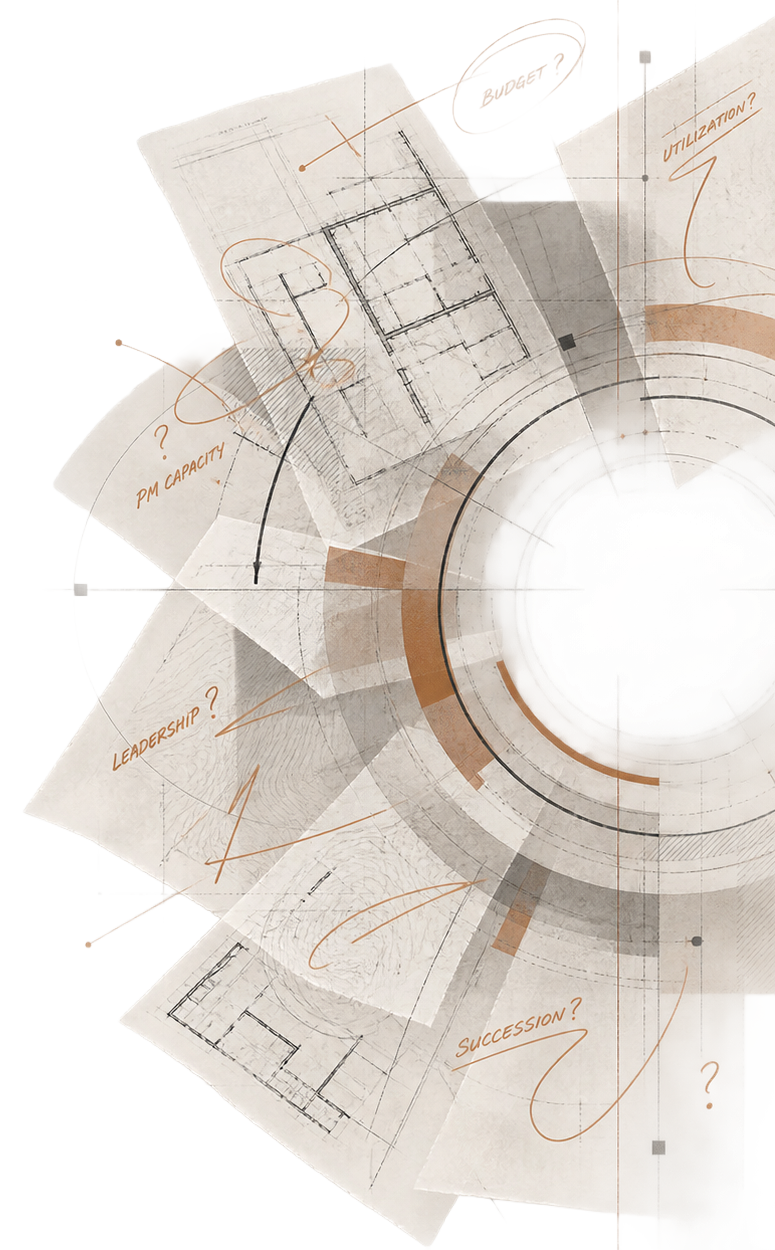
If several of these sound familiar, the problem is probably larger than project management.
The problem behind
the problems.
Recurring problems are rarely isolated failures. They are evidence that a firm’s systems are incomplete, misaligned, or no longer suited to the firm it has become.
Growth does not create these conditions. It reveals the ones already there, then amplifies them. Firms respond by fixing symptoms. The symptoms return, because nothing underneath them changed.

03 FOUNDER | STRATEGIST | ARCHITECT |
Founded from inside the INDUSTRY.
Nearly three decades inside architecture and engineering practice, leadership, ownership, and governance shaped the point of view behind Schemata. Aaron Jenks has worked as an architect, project manager, business developer, firm leader, owner, shareholder, and board member.
Schemata grew from that experience and from a recurring observation: firms rarely struggle because of one isolated issue. They struggle when the systems around their people no longer fit the firm they have become.
Aaron works directly with firm leadership. There is no team behind the curtain, and that is the point.
Schemata?
Schemata are the underlying structures that shape how people understand, organize, and act.
Every firm has them, whether intentionally designed or inherited over time. Schemata helps AEC leaders examine and strengthen the structures behind their work: Direction, People, Clients, Delivery, and Enterprise.

04 FRAMEWORK
Five systems. One firm.
A firm is not one system. It is five, and they have to work in concert.
“A weakness in one rarely stays isolated.”
The firm alignment
ASSESSMENT.
When the symptoms are clear, but the root cause is not, the six-week Firm Alignment Assessment provides an independent view of how the firm is actually working.
The assessment examines alignment across Direction, People, Clients, Delivery, and Enterprise, then identifies where friction is constraining the firm.
See where the firm is actually aligned, where it is not, and what to do next.
DISCUSS THE ASSESSMENT →06 PERSPECTIVES
PERSPECTIVE 001
Your PM problem is probably not a PM problem.
Management problems are often treated as individual performance problems. Train the PM. Replace the PM. Add another checklist. Tighten the process.
But when the same issues keep appearing across projects, teams, and offices, the problem is usually larger than the person carrying the title. The conditions around the PM may be creating the inconsistency the firm is trying to fix.
Ideas worth an argument.
Short essays on the conditions AEC leaders actually deal with, and what the usual advice gets wrong.

07 SCHEDULE A CONVERSATION
Let’s begin the CONVERSATION.
You do not need to have the problem fully figured out. Tell me what you are seeing, what keeps resurfacing, or simply what has you concerned.
01 Recurring issues keep resurfacing.
02 Leadership knows something is off but cannot quite name it.
03 Growth, ownership, or change is exposing strain in the firm.
04 Succession or ownership transition remains unresolved.
INITIAL CONVERSATION
A focused conversation to understand your firm, your challenges, and what success looks like.
NO OBLIGATION
This is an exploratory conversation, not a sales call. You will walk away with clarity either way.
CONFIDENTIAL
Your information and conversation are always treated with the highest level of confidentiality.
DECIDE WHAT’S NEXT
If it makes sense to work together, we will explore the right path forward. If not, you will still leave with valuable perspective.