
ORGANIZATIONAL ADVISORY FOR A/E FIRMS
Better firms do not happen by accident.
THEY ARE DESIGNED.
Recurring problems in A/E firms rarely exist in isolation. A staffing issue may begin with the work being pursued. A project problem may begin with unclear authority. Principal overload may point to something deeper in how the firm operates.
Schemata examines those connections across the firm, identifies the few conditions creating the most friction, and helps leadership decide what to address first.

Aaron D. Jenks, AIA, NCARB, LEED AP
Founder | AEC Advisor
Former A/E firm owner and principal with 30+ years inside the business of running, growing, and delivering work in an A/E firm.
Different firms.
FAMILIAR PROBLEMS.
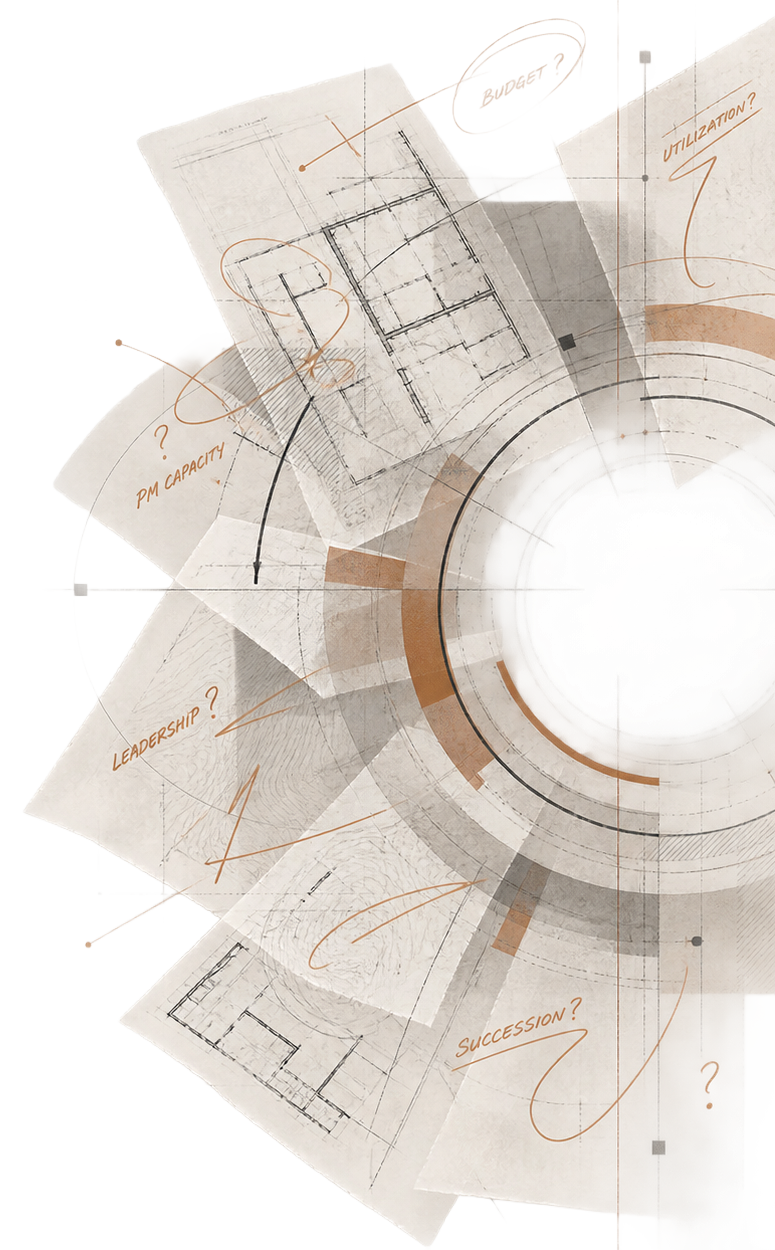
The visible problem is not always where it started. A project overrun may begin with a client commitment, a staffing decision, or responsibility assigned without the authority to act.
Schemata examines those connections across the firm to identify the few conditions creating the most friction and determine what needs to change first.
02 FRAMEWORK
Five systems. One firm.
The work you pursue, the commitments you make, and the people responsible for delivering them must work together.
The work you pursue, the commitments you make, and the people responsible for delivering them must work together.
Schemata examines five connected systems to understand where that alignment breaks down, where friction is being transferred, and which changes would make the greatest difference.
The systems are distinct, but never separate.
PROBLEMS OFTEN SHOW UP IN ONE SYSTEM AND ORIGINATE IN ANOTHER.

03 WHEN THE ROOT PROBLEM ISN’T CLEAR
The Firm Alignment ASSESSMENT
The Firm Alignment Assessment is a six-week, fixed-fee engagement for A/E firm owners who know something is not working but do not yet agree on why. Schemata examines how the firm is actually operating across the Five Systems, identifies the few conditions creating the most friction, and helps leadership decide what to change first.
A project overrun, for example, may begin with a client commitment, an unrealistic fee, a staffing decision, or unclear authority. The Assessment follows those connections rather than treating the visible problem in isolation.
Confidential interviews, operating data, and document review across the Five Systems.
WEEKS 1-4
DIAGNOSE
WEEKS 5-6
Findings are tested with leadership and translated into three priority decisions.
DECIDE
90 DAYS + 12 MONTHS
A practical action plan for the next 90 days and a priority roadmap for the year ahead.
SEQUENCE
Three Priority Decisions. Not 30 Recommendations

01 ACT NOW
Conditions consequential enough to require near-term action, clear ownership, and a defined first step.
02 PROTECT
Strengths, relationships, and operating practices the firm should preserve while making changes.
03 DEFER
Work that may matter later but would distract from the priorities that matter now.
04 WHEN THE ISSUE IS ALREADY DEFINED
When the issue is already
DEFINED.
The Firm Alignment Assessment is the starting point when leadership sees the symptoms but does not yet understand what is driving them.
When owners already understand the issue and need experienced judgment to make a consequential decision or move it forward, Schemata can work directly through Executive Advisory or a focused Strategic Intervention.
ADVISE
Executive Advisory
Independent counsel for A/E firm owners and senior leaders facing consequential decisions involving leadership, ownership, priorities, growth, succession, or organizational change.
Engagement: Custom-scoped around the decision, cadence, and level of support required.
FOCUS
Focused Advisory
Focused work on a defined organizational condition such as leadership transition, operating structure, decision authority, accountability, or client strategy, where concentrated outside judgment, facilitation, and design support are needed.
Engagement: Scope, duration, and working format are defined around the specific issue and desired outcome.
05 ABOUT
Built from inside A/E FIRMS.
More than 30 years working inside architecture and engineering firms shaped the point of view behind Schemata. Aaron Jenks has worked as an architect, project manager, business developer, firm leader, owner, shareholder, and board member.
Across those roles, the same pattern appeared repeatedly: capable people struggle when authority, information, commitments, and operating practices do not keep pace with the firm. What looks like an isolated staffing, project, or leadership problem often begins somewhere else.
FIRM OWNERSHIP + GOVERNANCE
Former principal, shareholder, and board member of a multidisciplinary architecture and engineering firm.
FIRM OPERATIONS + LEADERSHIP
Experience across staffing, leadership development, business development, organizational structure, project delivery, and governance.
PROJECT DELIVERY + ECONOMICS
Responsible for proposals, fees, staffing, client commitments, delivery oversight, and project profitability.

Aaron D. Jenks, AIA, NCARB, LEED AP FOUNDER | AEC ADVISOR
The person you hire is the person doing the work. Aaron works directly with owners and senior leaders from the first conversation through diagnosis, findings, and priority decisions.

06 PERSPECTIVES
Ideas worth an argument.
Practical observations on how A/E firms make decisions, organize work, and perform.
003
PERSPECTIVE
The Firm Changed. Did the Way You Run It?
In Perspective 003, I discuss what tends to shift as a firm grows, why the habits that built it can become its constraint, and one question I think every ownership group should ask every few years.
EARLIER PERSPECTIVES
001
Your PM problem is probably not a PM problem.
002
We delegate the expectation of Success.
Let’s begin the CONVERSATION.
You do not need to have the problem fully figured out. Tell me what you are seeing, what keeps resurfacing, or what has you concerned.
Recurring issues keep resurfacing despite repeated attempts to fix them
Leadership knows something is not working but does not yet agree on why.
Growth, ownership change, or increasing complexity is exposing strain in the firm.
Too much still depends on the same few principals or senior leaders.
07 SCHEDULE A CONVERSATION
INITIAL CONVERSATION
A focused discussion about what you are seeing, where the strain is showing up, and what may be worth examining.
NO SALES PITCH
The first conversation is exploratory. If Schemata is not the right fit, I will say so.
DECIDE WHAT’S NEXT
If there is a clear fit, we will determine whether the right next step is an Assessment, Executive Advisory, or Focused Advisory engagement.
CONFIDENTIAL
Firm information and conversations are treated with discretion from the first exchange..